Amazon can show a healthy FBA inventory position while your Shopify store is draining the same SKU faster than expected. Your spreadsheet says you have 45 days of coverage. In reality, a supplier lead time, an inbound delay, and one strong promotion can turn that number into a stockout. The top multichannel replenishment strategies start by treating inventory as one capital pool serving several demand streams, not a set of separate channel reports.
For ecommerce operators, replenishment is not just an ordering task. It is the decision that determines whether cash sits in slow-moving units, Amazon ads drive shoppers to unavailable products, or a winning SKU stays in stock long enough to compound profitable sales. The goal is simple: buy the right quantity, at the right time, with enough visibility to act before options disappear.
Build One Demand Signal Across Every Channel
The fastest way to create bad purchase orders is to forecast Amazon FBA, FBM, Shopify, and other sales channels in isolation when they compete for the same sellable inventory. A channel-specific view can be useful for allocation, but it should not be the sole basis for what you buy from a supplier.
Start with a unified SKU-level demand view. Combine fulfilled sales, open orders where appropriate, returns patterns, current inventory by location, in-transit purchase orders, and planned inbound quantities. Then separate the question of total demand from the question of where inventory should be positioned.
That distinction matters. If Amazon represents 70% of sales but Shopify has accelerated from 10% to 25%, your next supplier order should reflect total demand. Your Amazon shipment decision should reflect the quantity Amazon needs before its next practical replenishment window. Mixing those decisions is how brands either starve a channel or send too much product into an expensive storage position.
Data quality comes first. Map every channel SKU to the correct parent product and selling unit. A two-pack on Shopify and a single unit on Amazon are not interchangeable demand records. Normalize them into base units before forecasting. This is unglamorous work, but it prevents a forecast from looking mathematically precise while being operationally wrong.
Forecast at the SKU Level, Not at the Company Average
Averages hide the behavior that drives inventory risk. One SKU may sell steadily every day. Another may spike around paydays, promotions, or seasonal events. A third may be newly launched with too little history for a standard forecast to be trustworthy.
Use a model that fits the SKU’s actual sales pattern. Stable, high-volume products can often support a trend and seasonality-based forecast. Intermittent items require methods designed for sporadic demand. Fast-growing products need a process that recognizes growth without assuming every recent spike is permanent.
This is also where many teams overcorrect. They see a seven-day surge and order for a new normal. Or they see one soft month and slash a purchase order, only to stock out during the next replenishment cycle. Demand planning needs guardrails: outlier handling, promotional annotations, seasonal comparison periods, and forecast review thresholds for meaningful exceptions.
Four years of history can be valuable for identifying recurring seasonality, but historical data is not a substitute for judgment. A product with a new price point, revised listing, changed ad strategy, or expanded channel mix may need an explicit adjustment. The disciplined approach is to document the adjustment, measure its result, and return to the baseline model when the event has passed.
Treat promotions and ads as inventory decisions
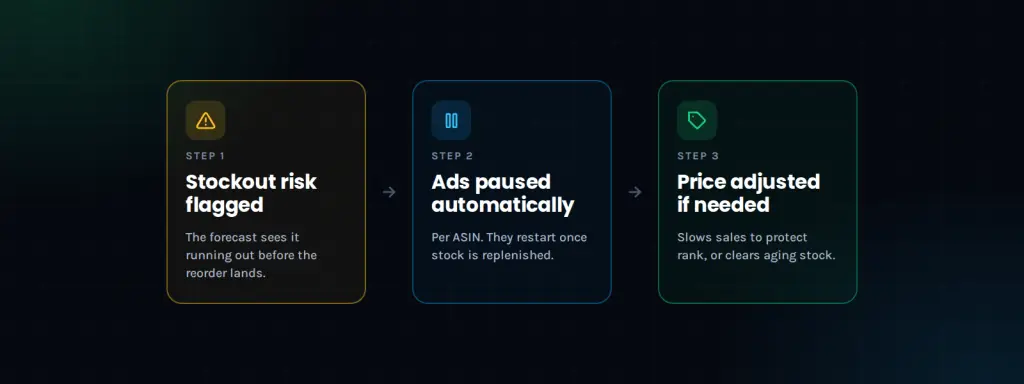
Advertising does not create unlimited demand capacity. If a SKU has only enough inventory to cover its normal run rate through a supplier lead time, increasing spend can simply accelerate a stockout. That can cost contribution margin today and ranking momentum later.
Create a simple operating rule: before scaling campaigns or launching a promotion, confirm that projected available inventory covers expected incremental demand through the next replenishment opportunity. If it does not, reduce spend, limit the offer, or delay the campaign. Marketing and inventory should work from the same demand assumptions, not discover the conflict after sales begin.
Calculate Reorder Points From Real Constraints
A reorder point should answer one operational question: when must we commit to the next order so inventory does not fall below the required protection level before replenishment arrives?
The formula is straightforward in principle: expected demand during lead time plus safety stock. The difficult part is using real inputs. Lead time is not just supplier production time. It may include supplier processing, freight, receiving delays, appointment timing, and the time required to make inventory available for the channel that needs it.
Safety stock should not be a fixed percentage applied to every SKU. A high-margin, fast-selling SKU with uncertain demand and a long lead time deserves more protection than a slow mover with reliable replenishment. Consider demand volatility, forecast error, lead-time variability, stockout cost, unit economics, and the service level you actually want to maintain.
Do not set an aggressive in-stock target for every product by default. A 99% service goal consumes more working capital than a 95% goal, especially for variable demand. For strategic hero SKUs, that investment may be justified. For long-tail products with weak margins, it may not be. Replenishment is a profitability decision, not a contest to achieve the highest possible coverage number.
Plan in Two Layers: Supplier Orders and Channel Allocation
Supplier ordering and channel replenishment need connected but separate plans. The supplier plan determines total units ordered based on the long-term demand outlook, supplier lead time, minimum order quantities, order cadence, and cost. The allocation plan determines how those units are deployed across Amazon FBA, AWD, FBM, Shopify, or other selling channels.
This two-layer approach prevents a common mistake: placing a correct total purchase order but putting too much inventory in the wrong place. Amazon capacity limits, storage costs, inbound timing, and channel demand can all change the best allocation.
Set allocation rules by SKU class. A proven Amazon bestseller may warrant a larger FBA buffer because the cost of going out of stock is high. A volatile or newly launched SKU may be better held in a more flexible position until demand stabilizes. Products that sell across channels need a reserve policy so one channel does not consume inventory required for a higher-priority commitment.
Review the plan on a regular cadence, but do not confuse frequent review with constant manual interference. Weekly exception review is usually more useful than rebuilding every forecast every day. Focus attention on SKUs with projected stockouts, excess coverage, material forecast changes, delayed purchase orders, or channel allocation gaps.
Put Supplier Rules Inside the Replenishment Process
A theoretically perfect order quantity is worthless if it violates the supplier’s MOQ, case-pack requirements, ordering calendar, or payment terms. Those constraints need to be built into the recommendation, not handled as a last-minute spreadsheet correction.
For each supplier, maintain usable lead-time assumptions, minimums by SKU or order, order frequency, unit costs, and any meaningful seasonal constraints. Then evaluate purchase orders at both the SKU and supplier level. A SKU may be below its reorder point, but the best action could be to wait until the next approved supplier order date if the resulting stockout risk remains acceptable. In another case, the financial impact of a stockout may justify an expedited order.
When cash is tight, rank proposed orders by risk and return. Prioritize products with strong contribution margin, dependable sell-through, and an urgent projected inventory gap. Be more cautious with items that already have long coverage, weak velocity, or uncertain demand. This is how a replenishment process protects cashflow instead of merely generating a longer buy list.
Automate the Work, Keep Humans on Exceptions
Spreadsheets can handle a small catalog and a stable channel mix. They become fragile when teams add hundreds of SKUs, multiple suppliers, changing Amazon inventory states, in-transit orders, and several demand channels. The issue is not that spreadsheets are incapable of calculations. It is that they depend on manual updates, version control, and people remembering which exception changed the last forecast.
A purpose-built planning workflow should consolidate sales and inventory data, select an appropriate forecast at the SKU level, apply supplier rules, and produce clear reorder recommendations. It should also make the action visible: create the supplier-ready purchase order, confirm expected arrivals, and prepare channel replenishment decisions.
Inventory Optimizer is designed around that operating reality, bringing multichannel demand, Amazon inventory, purchase orders, and supplier constraints into one planning workflow. The value is not another dashboard. It is fewer guesswork orders and faster action when a product is heading toward a stockout or tying up too much capital.
Measure Replenishment by Business Outcomes
Forecast accuracy matters, but it is not the only scorecard. Track stockout days, excess inventory coverage, aged inventory exposure, inventory turns, cash tied up in open purchase orders, and the percentage of purchase orders created on time. For Amazon-centered brands, also watch how inventory availability affects advertising efficiency and sales momentum.
Review errors by cause. Was demand unusually volatile? Did a supplier miss lead time? Did the forecast exclude a promotion? Was inventory allocated to the wrong channel? This turns planning from a monthly blame exercise into a system that gets more reliable with each cycle.
The best replenishment process is not the one with the most formulas. It is the one that gives your team enough lead time to make a profitable choice. When every SKU has a credible demand signal, supplier constraints are already accounted for, and channel inventory is planned deliberately, your next purchase order becomes a decision you can defend – not another Sunday spent reconciling tabs.