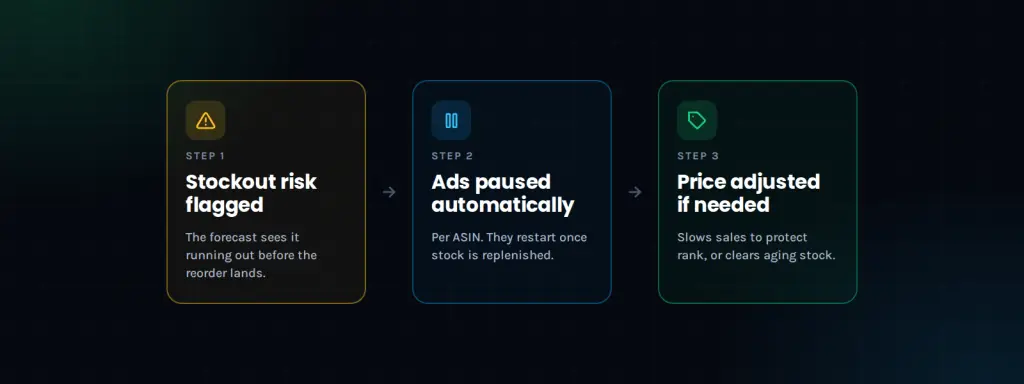
Stockouts do not just cost revenue. They can damage ranking, force rushed purchasing decisions, and leave ad campaigns spending against inventory that will not last. Overstock creates a different problem: cash gets trapped in slow-moving SKUs while storage fees and aged inventory risk keep growing. The top ecommerce forecasting platforms help brands replace those expensive guesses with SKU-level demand signals, reorder recommendations, and purchase plans tied to real supplier constraints.
The right choice depends on where your operation is breaking down. A Shopify-first brand may need a fast, approachable planning layer. An Amazon-heavy operator needs to account for FBA, AWD, FBM, inbound inventory, sales velocity, and marketplace-specific replenishment rules. A multi-brand agency needs repeatable controls across accounts without rebuilding spreadsheets every Monday.
What separates useful forecasts from expensive dashboards
A chart that projects next month’s sales is not enough. Inventory planning becomes useful only when the forecast leads to an action: how much to order, when to place the PO, whether available stock supports current ad spend, and which SKUs need attention now.
Start with the data each platform can use. At a minimum, it should reconcile historical sales, current inventory, open purchase orders, lead times, and supplier minimum order quantities. For Amazon sellers, it should also distinguish inventory that is available to sell from inventory that is in transit or allocated across fulfillment methods. If a tool cannot see the full inventory position, its recommendation can be confidently wrong.
Modeling depth matters too. Seasonal products, steady replenishment items, new launches, and erratic long-tail SKUs should not all receive the same forecast treatment. Good platforms account for these differences, but the practical test is simpler: can your team understand the assumptions, adjust a bad input, and act on the resulting recommendation?
7 top ecommerce forecasting platforms to consider
These platforms are not interchangeable. Some are built around Amazon replenishment, while others focus on Shopify brands or broader purchase planning. Treat this as a shortlist for matching your operational requirements, not a universal ranking.
1. Inventory Optimizer
Inventory Optimizer is designed for Amazon-centered and multichannel brands that need forecasting to become an operating workflow. It centralizes sales and inventory data across Amazon FBA, AWD, FBM, Shopify, QuickBooks, ShipStation, and file-based sources, then applies SKU-level model selection across more than 100 statistical and machine-learning models.
Its fit is strongest when supplier lead times, MOQs, reorder cadence, landed costs, and purchase-order execution all affect the decision. Teams can plan up to 12 months ahead, create supplier-ready POs, and use inventory signals to avoid pushing ad spend when stock coverage is too thin. That level of operational control is more than a lightweight forecasting app, so it is best suited to brands and agencies ready to move beyond spreadsheet planning.
2. Inventory Planner
Inventory Planner is a familiar option for merchants selling through Shopify and other ecommerce channels. Its strengths are demand forecasting, replenishment suggestions, purchasing workflows, and accessible reporting for operators who want to bring planning into one place.
It can be a sensible choice for a growing brand with a relatively straightforward supplier network. Before committing, confirm how it handles Amazon-specific inventory states, multichannel allocation, and the level of forecast customization your assortment requires. A simple interface is valuable, but not if it masks inventory that is unavailable for immediate sale.
3. Flieber
Flieber is focused heavily on inventory planning for consumer brands, with an emphasis on demand forecasting and allocation decisions across sales channels. It is often considered by operators who want to balance inventory availability across ecommerce and marketplace demand without relying entirely on broad average sales rates.
This can be especially useful for brands with meaningful channel variation or a large catalog that requires prioritization. Evaluate how its workflow fits your purchasing process and whether its supplier rules reflect the constraints that actually determine when you can reorder.
4. Cogsy
Cogsy positions itself around inventory intelligence and cash-flow-aware planning for ecommerce brands. Its appeal is the connection between demand plans, buying decisions, and the financial consequences of ordering too much or too little.
For founders and finance teams, that framing can make planning conversations more concrete. It may be a strong fit when cash planning is a major concern and the team wants visibility into future purchasing needs. Larger Amazon operators should still test the detail of its Amazon data handling and purchase-order controls against their real workflow.
5. Prediko
Prediko is geared toward Shopify merchants looking for an approachable way to forecast demand, manage purchase orders, and plan replenishment. Its Shopify orientation can shorten the path from store data to a usable forecast for teams that do not need extensive marketplace complexity.
That focus is also the trade-off. If Amazon is a major revenue channel, ask whether the platform can produce one trusted demand plan across every channel instead of treating marketplace sales as an afterthought. The more fragmented the data, the less useful a channel-specific forecast becomes.
6. SoStocked
SoStocked is an Amazon-focused inventory management and forecasting platform. It is worth consideration for sellers who need tools built around Amazon replenishment, stockout prevention, restock timing, and the planning realities of a marketplace catalog.
Its specialization can be an advantage for operators whose business is primarily Amazon. Brands with fast-growing Shopify, wholesale, or other sales channels should validate whether the platform’s consolidated view is sufficient for their planning needs. A forecast based on only part of demand can encourage underbuying at exactly the wrong time.
7. Fabrikator
Fabrikator focuses on inventory planning and purchase-order management for commerce businesses. Its tools can help teams translate demand expectations into purchasing plans, supplier communication, and inventory visibility without maintaining every calculation manually.
It is a reasonable candidate for brands that want a planning system with strong purchasing discipline. As with every platform, assess the forecast method rather than assuming automation equals accuracy. Ask how it treats promotions, stockout periods, new products, long supplier lead times, and items with irregular sales patterns.
How to choose among ecommerce forecasting platforms
Do not buy based on the prettiest dashboard or the biggest list of integrations. Run each contender through a sample of the decisions that create the most pressure in your business: a fast-selling Amazon SKU with low coverage, a seasonal item with a long lead time, a slow mover that is tying up cash, and a supplier order that must meet an MOQ.
First, inspect data accuracy. Reconcile a few SKUs against the source systems and confirm that on-hand, inbound, committed, and sellable quantities are represented correctly. Second, inspect forecast behavior. The platform should explain how it responds to sales spikes, promotions, stockouts, and changing trends rather than simply presenting a number.
Then inspect execution. A useful planning system should calculate reorder dates and quantities with supplier constraints in mind, then make it easy to turn approved recommendations into purchase orders and inbound shipment actions. If your team still exports data, edits it in a spreadsheet, and re-enters it elsewhere, the platform has not removed the operational risk.
Finally, evaluate portfolio scale. Agencies and multi-brand operators need account separation, repeatable settings, and enough automation to keep analysts focused on exceptions rather than routine calculations. A tool that works for one catalog may become another full-time spreadsheet project at ten.
Make the platform prove its value before rollout
Use a trial or pilot to compare recommendations against your current process. Measure stock coverage, projected stockouts, excess units, purchase-order cycle time, and the cash tied up in inventory. More importantly, review where the platform disagrees with your planner. Those exceptions reveal whether its logic understands your business or merely reports its data.
The best forecasting platform is the one your team can trust when the next purchase decision is expensive. Start with the SKUs that keep you up on Sunday night, validate the recommendations against supplier reality, and build from there.