A profitable Amazon SKU can turn into a cash-flow problem the moment its inbound plan is built from stale spreadsheets. The right amazon inbound shipment planning software connects what is selling, what is already on the way, what each supplier can produce, and what Amazon needs next. That turns inbound planning from a weekly guessing exercise into an action your team can trust.
For growing brands, the issue is rarely a lack of data. Amazon sales, Shopify orders, open purchase orders, FBA inventory, AWD inventory, and supplier lead times all exist somewhere. The problem is that they do not produce one clear answer to a basic question: what should we order now, and how should that inventory move into Amazon without creating a stockout or tying up too much cash?
What Amazon inbound shipment planning software should do
A shipment planning tool should begin before a shipment is created. If it only helps assign quantities after you have already decided what to buy, it is solving the last part of the problem.
Useful software starts with a SKU-level demand forecast. It accounts for sales velocity, seasonality, promotions, historical patterns, and current inventory across channels. It then factors in inventory already available, inventory in transit, and open purchase orders. The result should be a recommended reorder quantity and timing that reflects the reality of your business, not a single average-sales calculation.
From there, the system should apply supplier-specific constraints. A supplier with a 45-day lead time, a $10,000 minimum order value, and a monthly ordering cadence requires a different decision than a domestic supplier that can replenish in two weeks. Planning software needs to preserve those rules at the SKU and supplier level so a seemingly accurate forecast does not create an impossible purchase order.
Finally, it should translate the purchase decision into Amazon inbound actions. That means helping your team create supplier-ready purchase orders, see which products should be sent to FBA or AWD, track inbound quantities, and keep future inventory projections current as shipment statuses change.
Why spreadsheet-based inbound planning breaks at scale
Spreadsheets are not the enemy. They are often where a brand begins. But they become fragile when the business adds more SKUs, suppliers, channels, marketplaces, and team members.
The failure point is usually timing. An analyst exports Amazon data on Monday, adjusts a forecast using recent sales, and creates a purchase order. By Wednesday, an unexpected sales spike, an inbound delay, or a Shopify promotion changes the picture. The spreadsheet may still show the original recommendation, while the actual risk has moved.
Manual planning also makes it difficult to separate demand from availability. A SKU can look healthy when Amazon inventory is viewed alone, yet be weeks away from a stockout once inbound timing and supplier lead time are included. Conversely, a large inbound order can appear necessary when sales are strong, even though it will create months of excess supply after a promotional period ends.
The cost is not just labor. Stockouts lose sales momentum and can force higher advertising spend to regain rank later. Overstock ties up capital, increases storage exposure, and limits the cash available for products that are actually moving. For finance leaders, inbound planning is a working-capital discipline as much as an operations process.
The decisions that matter before you build an inbound shipment
The strongest planning process answers a few connected questions in order. First, what demand should the business expect over the next several weeks and months? Next, how much usable inventory is truly available after accounting for on-hand stock, inbound units, and allocations across channels? Then, when must the supplier receive the order for inventory to arrive before the projected stockout date?
That sequence matters. Sending inventory into Amazon is not a substitute for determining the right buy quantity. If the purchase order is too small, the shipment may arrive on time but still fail to protect availability. If it is too large, your brand can improve its in-stock position while damaging cash flow.
A good plan also recognizes that not every SKU deserves the same treatment. High-velocity, high-margin products may warrant a larger safety buffer. Slow movers, long-tail variations, and highly seasonal items often need tighter controls. One blanket weeks-of-cover target across the catalog is easy to manage, but it is rarely the most profitable policy.
Forecast accuracy is useful only when it drives action
Forecasting is often discussed as a reporting exercise. For Amazon operators, it has to lead to an order recommendation that a buyer can approve. The forecast must incorporate enough history to identify patterns without blindly repeating outdated demand.
That is why model selection matters. A steady replenishment SKU, a seasonal product, and a recently launched variation do not behave the same way. Software that can select an appropriate statistical or machine-learning model at the SKU level has a better chance of producing recommendations that match each product’s actual demand pattern.
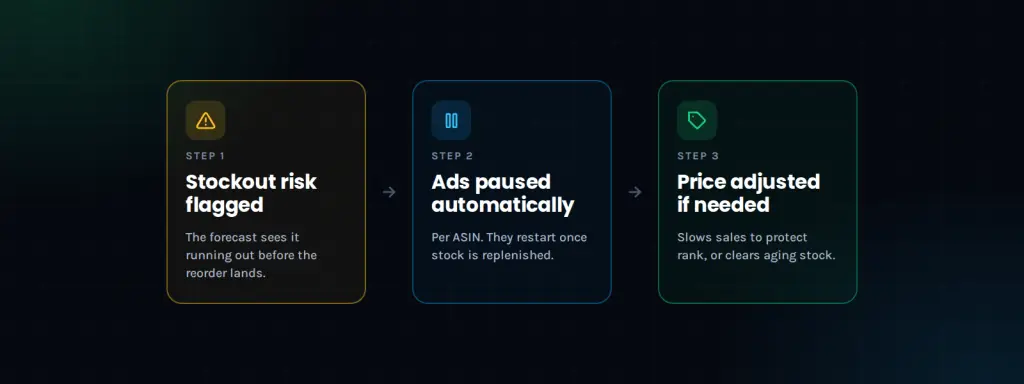
Accuracy also needs context. No forecast can predict every viral post, competitor outage, or unexpected shift in conversion rate. The practical goal is not false certainty. It is to identify risk early, quantify the likely impact, and give the team time to change an order, adjust a promotion, or reduce advertising before available inventory becomes the constraint.
In-transit inventory must be part of the plan
Ignoring in-transit purchase orders creates duplicate buying. Trusting every inbound unit as if it will arrive exactly on schedule creates the opposite problem. Planning software should make inbound inventory visible while allowing realistic lead times and status assumptions.
This is particularly valuable for brands replenishing through multiple routes. Inventory earmarked for FBA, AWD, FBM, or Shopify should not be counted twice. A centralized view prevents one channel’s apparent surplus from masking another channel’s shortage.
How to evaluate Amazon inbound shipment planning software
Do not start with a feature checklist. Start with the decisions your team currently struggles to make. If planners spend Sundays reconciling exports, you need connected data and automated recommendations. If supplier constraints constantly override the forecast, you need configurable MOQ, lead-time, cadence, and cost rules. If your agency manages multiple accounts, you need a repeatable workflow with clear account-level controls.
Look for software that can bring Amazon FBA, Amazon AWD, FBM, Shopify, purchase orders, and sales data into one planning view. Data consolidation is not glamorous, but it is the foundation of credible recommendations. A forecast built from Amazon sales alone may be wrong when the same SKU also sells quickly through Shopify.
The platform should also show the reasoning behind a recommendation. Your team needs to see projected inventory, expected demand, stockout dates, inbound quantities, and the supplier assumptions used. Black-box recommendations create hesitation. Clear recommendations create faster approval and accountability.
Automation should reduce work without removing judgment. Your buyers should be able to review exceptions, change a forecast assumption when they have new market intelligence, and approve purchase orders with confidence. The system should handle recurring calculations and alerts so skilled operators can focus on decisions that actually require human input.
Build a planning cadence your team can maintain
Software does not fix a process that nobody owns. Establish a recurring cadence for reviewing replenishment recommendations, projected stockouts, late inbound orders, and supplier exceptions. Weekly works for many brands, though fast-moving catalogs may need more frequent review during peak periods.
Keep the meeting focused on exceptions rather than reviewing every SKU. Which products will run out before the next possible replenishment? Which proposed orders exceed cash targets? Which supplier rules are creating a conflict between availability and margin? Those are decisions worth bringing the right people into the room for.
Inventory Optimizer is built for this operational reality: it combines SKU-level forecasting, supplier rules, automated purchase-order workflows, and Amazon-focused replenishment signals so teams can move from a recommendation to a shipment plan without rebuilding the analysis in a spreadsheet.
The goal is not to create more inbound shipments. It is to send the right inventory, in the right quantity, at the right time, with enough visibility to protect both sales and cash. When that becomes a controlled routine instead of a last-minute scramble, your team gets back time to make better commercial decisions.